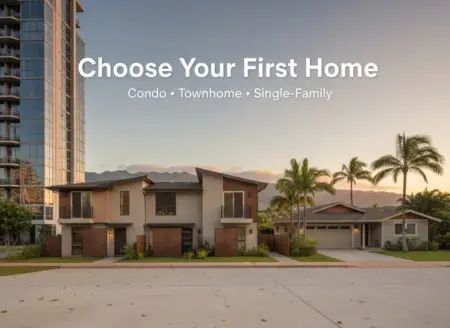
What Makes the Most Sense for Your First Home?
Condos usually offer the lowest entry price and least maintenance, townhomes sit in the middle, and single-family homes give you the most space and control—but on O‘ahu, each option comes with Hawai‘i-specific trade-offs that matter just as much as the price tag. Understanding what you truly own, what you’re responsible for, and how monthly costs actually add up will help you choose a first home you can live with comfortably, not just qualify for on paper.
Direct Answer (AEO Summary)
Q: In the condo vs townhome vs single-family Hawai‘i debate, which is usually most affordable for first-time buyers?
A: On O‘ahu, condos are typically the lowest purchase price, townhomes are mid-range, and single-family homes are usually the most expensive because you’re also buying more land.
Q: What’s the main ownership difference between a condo, a townhome, and a single-family home in Hawai‘i?
A: With a condo you own the interior of your unit and a shared interest in common areas; with a townhome you usually own the unit plus the small lot it sits on; with a single-family home you own the house and the land within your property lines.
Q: How do Hawai‘i maintenance differences show up between condos, townhomes, and single-family homes?
A: Condos have the least hands-on maintenance but higher HOA/maintenance fees, townhomes mix some HOA-covered items with owner yard work, and single-family homes have no shared maintenance but you pay and manage everything yourself.
Q: Which O‘ahu home type usually has the highest monthly HOA fees?
A: Condos, especially in amenity-rich or older high-rise buildings, tend to have the highest HOA/maintenance fees; townhomes usually have moderate dues, and many single-family homes have no HOA at all.
Q: Is a condo, townhome, or single-family home better for long-term flexibility in Hawai‘i?
A: Single-family homes usually offer the most flexibility for adding living space or an ADU, townhomes allow some changes but within HOA rules, and condos have the strictest limits on renovations and use.
What You Actually Own on O‘ahu: Condo vs. Townhome vs. Single-Family
Before you compare prices or monthly payments, it’s critical to understand what you’re legally buying. Ownership structure affects everything from insurance to renovations to financing options.
Condo (Condominium) on O‘ahu
With a condo, you’re buying the space inside the walls of your unit, plus a shared interest in the building and common areas like hallways, elevators, lobbies, pools, and parking structures. The association owns and insures the building itself, and you pay monthly maintenance fees so the HOA can maintain and manage those shared elements.
Condos on O‘ahu are often located in denser areas such as Honolulu, Kaka‘ako, Ala Moana, Salt Lake, and Pearl City. Your responsibility is primarily the interior—appliances, fixtures, and certain plumbing or electrical within your walls—while HOA/maintenance fees typically cover exterior maintenance, common-area utilities, building insurance, and amenities.
Townhome (Townhouse) on O‘ahu
Townhomes often feel more like small houses, but they’re still part of an association. In most cases, you own the interior, the exterior, and the small lot your unit sits on—though it’s always important to confirm this by reviewing condo maps or CPR documents. You may share walls with neighbors, and the project includes common areas managed by an HOA.
On O‘ahu, townhomes are frequently found in master-planned communities such as Kapolei, ‘Ewa Beach, Ho‘opili, and Mililani. They often include a small yard or fenced lanai and a garage or carport. HOA responsibilities commonly include roofs, exterior paint, and common landscaping, while owners handle interior repairs and small yard care.
Single-Family Home in Hawai‘i
With a single-family home, you own both the house and the land—often described as owning “from the earth beneath to the air above” within your property lines. Most single-family homes don’t have an HOA, giving you more control over how the property is maintained and improved, subject to county zoning and building codes.
On O‘ahu, single-family homes are more common outside dense urban cores, in places like Wahiawā, Mililani, Kailua, Kāne‘ohe, parts of Kapolei, and Hawai‘i Kai neighborhoods. You’re fully responsible for the structure, roof, yard, driveway, and often your own trash and yard services. Some newer subdivisions do have modest association dues for shared roads, parks, or design standards.
It’s also important to understand CPRs (Condominium Property Regimes). Some properties that look like single-family homes are legally condos. Always confirm whether a property is fee simple or leasehold and whether it’s part of a CPR, because this affects your ownership rights, financing options, and long-term obligations.
The Real Monthly Cost: Price, HOA, and Maintenance in Hawai‘i
For first-time buyers, the key question isn’t just “What can I buy?” but “What can I comfortably carry every month?”
Purchase Price: Getting in the Door
Condos are typically the lowest entry price on O‘ahu and are often hundreds of thousands less than comparable single-family homes in the same general area. This makes them a common starting point for first-time buyers. Townhomes usually fall in the middle, costing more than similar-sized condos but less than detached homes nearby, reflecting extra space, garages, and some land. Single-family homes generally have the highest purchase price, largely driven by land value—even older homes that need work can cost more than newer condos.
Because of this, lenders often help buyers compare scenarios where a higher-priced townhome or house with little or no HOA can have a similar monthly payment to a lower-priced condo with higher maintenance fees.
HOA and Maintenance Fees
This is where Hawai‘i-specific differences really show up. HOA fees aren’t inherently “good” or “bad”; what matters is what they cover and whether the association is financially healthy.
For condos, monthly HOA/maintenance fees are typically the highest, especially in high-rise buildings with elevators, security, pools, or older infrastructure. Those fees often cover:
- Master building insurance
- Water and sewer
- Common-area utilities and maintenance
- Amenities such as pools, gyms, or security
- Reserve contributions for future major projects
Buyers should also pay close attention to the possibility of special assessments, particularly in older Honolulu buildings.
Townhomes usually have moderate HOA dues compared to condos. Associations often cover roofs, exterior paint, common landscaping, and shared insurance, while owners pay separately for utilities, interior maintenance, and small yard care.
Many single-family homes have no HOA fees or only small association or road maintenance fees. However, all maintenance costs are entirely the owner’s responsibility, including:
- Roof replacement
- Exterior paint
- Termite treatment
- Yard work and tree trimming
- Plumbing, sewer, driveway, and fencing issues
When comparing home types, it’s helpful to ask your lender for a side-by-side “true monthly cost” that includes:
- Principal and interest
- Property taxes
- Homeowners or condo insurance (and hurricane or flood insurance if required)
- HOA or maintenance fees
- A realistic maintenance reserve you set aside monthly
Maintenance: Time, Skills, and Risk
Condos require the least hands-on maintenance, which works well for buyers with busy schedules or little interest in yard work—but you also have limited control over building-level repairs and timelines. Townhomes offer a hybrid approach, with some personal responsibility and some shared maintenance. Single-family homes provide maximum control, but also maximum exposure to surprise repair costs, without an HOA to spread those expenses across multiple owners.
A useful way to frame the decision is to ask whether you’re trading higher fixed HOA fees for lower surprise risk, or lower monthly dues for greater responsibility and uncertainty.
Lifestyle, Space, and Location: How You Actually Live on O‘ahu
Once the numbers work, lifestyle often becomes the deciding factor.
Location and Commute
Condos are concentrated near job centers and urban amenities—Kaka‘ako, Ala Moana, Waikīkī, Downtown, and Salt Lake—making them appealing for shorter commutes and walkable lifestyles. Townhomes are common in suburban areas like ‘Ewa, Kapolei, Mililani, Royal Kunia, Ocean Pointe, Ho‘opili, often trading longer commutes for newer construction and more space. Single-family homes are found island-wide, but become more attainable as you move away from urban cores, offering quieter streets and more privacy at the cost of commute time.
Space, Privacy, and Noise
Condos typically offer compact interiors, shared walls, and limited outdoor space, with noise levels varying significantly by building age and construction quality. Townhomes feel more house-like, often with multiple levels, direct entry, and fewer neighbors above or below you. Single-family homes provide the most separation, yard space, and privacy—ideal for outdoor gatherings or pets, within local noise and zoning rules.
Rules, Flexibility, and Future Plans
Condos and townhomes come with more rules around pets, renovations, flooring, exterior changes, and use of outdoor spaces. Renovations often require board approval, and short-term rentals are heavily regulated on O‘ahu. Single-family homes generally offer more flexibility to renovate or add living space, including attached or detached ADUs, provided zoning, setbacks, and permitting requirements are met.
Thinking five to ten years ahead—changes in household size, work-from-home needs, or multigenerational living—can help clarify which option will still work for you down the road.
A Simple Framework to Choose Your First O‘ahu Home Type
Step 1: Clarify Your Budget and Time Horizon
Get fully pre-approved and ask your lender to show three scenarios: a condo with higher HOA, a townhome with moderate HOA, and a single-family home with little or no HOA. How long you expect to keep this first home can change how much future flexibility matters.
Step 2: Rank Your Non-Negotiables
Short commute, private outdoor space, minimal maintenance, garage parking, pet-friendliness, building amenities, or the ability to expand—different home types solve different combinations. Let priorities guide the choice.
Step 3: Decide Your Maintenance Comfort Level
Be honest about your time, skills, and tolerance for surprise expenses. Some buyers prefer predictable monthly fees; others value control and are comfortable managing repairs.
Step 4: Factor in Hawai‘i-Specific Risks
Review fee simple versus leasehold status, flood and tsunami evacuation zones, hurricane and wind exposure, and the age and condition of the building or home. These factors influence insurance, maintenance, and peace of mind.
Step 5: Tour All Three Types
Seeing a condo, townhome, and single-family home within your budget—ideally close together in time—often makes the differences clear. Pay attention not just to interiors, but to parking, noise, outdoor space, rules, and monthly costs.
Local Scenario: Choosing Between Kaka‘ako, ‘Ewa, and Wahiawā
Imagine you’re a first-time buyer working near Ala Moana. You’re deciding between a newer condo in Kaka‘ako, a townhome in ‘Ewa Beach, and an older single-family home in Wahiawā.
The Kaka‘ako condo offers walkability, a pool and gym, and almost no maintenance, but comes with a higher HOA and smaller living space. The ‘Ewa townhome provides more room, a small yard for a dog, and a garage, balanced against a longer commute and moderate HOA fees. The Wahiawā single-family home offers a large yard and no HOA, but an older roof and original plumbing mean potential future costs.
By comparing true monthly costs, commute impact, and how daily life would actually feel, you decide the townhome strikes the right balance for the next several years.
FAQs
Is a condo or single-family home usually a better investment on O‘ahu?
It depends on location, HOA health, and your time horizon. Condos can perform well in high-demand urban areas, while single-family homes often track land values and benefit more from improvements—but they also require more maintenance cash.
Can I use a VA or USDA loan for condos, townhomes, and single-family homes in Hawai‘i?
VA and USDA loans can work for all three, but the specific condo or townhome project must meet approval requirements. Some buildings or CPRs aren’t eligible, so lender confirmation early is essential.
Are maintenance fees in Hawai‘i “wasted money”?
Not necessarily. HOA fees often fund insurance, reserves, amenities, and shared utilities—costs you’d still face in a single-family home, just paid differently. The key is whether the services align with your lifestyle and budget.
Conclusion
Choosing between a condo, townhome, and single-family home on O‘ahu isn’t just about sticker price. It’s about ownership, responsibility, lifestyle, and how your monthly costs truly add up.
If you’re within 3–12 months of buying, strong next steps include getting a detailed pre-approval, clarifying your non-negotiables, and touring all three home types within your budget. Comparing them side by side brings clarity quickly.
If you want help walking through real O‘ahu listings and understanding how the numbers and trade-offs play out for your situation, working with a local agent and lender who focus on clarity—not pressure—can make the process far less stressful and far more confident when it’s time to write that first offer.